Tallit and Tzitzit
-hebraicstudies.net-
Please do NOT visit this site on שַׁבָּת - Shabbat or on the ‘מוֹעֲדִים - Mo’a’dim - Appointed Feasts!
“This is My Name Forever, and this is My Memorial to all Generations.” Shemot - Exodus
3:15. (JPS).
“I am יְהוָה, that is My Name; and My glory will I
not give to another”. Yeshayahu – Isaiah 42:8. (JPS)
Throughout this site I may use
any of the following three versions of the TaNaKh: 1. “Jewish
Publication Society” (JPS), 2. “Sefaria.org” (SEF), 3. “Mechon-Mamre.org” (MEC).
Colour coded details of the – TaNaKh ... 1. Torah = History & Law, 2. Nevi’im = The Prophets. 3. *Ketuvim = and all other Writings).
*The Ketuvim - Includes, Poetical books -
Psalms, Proverbs, Job, the Megillot, or
Scrolls - Song of Solomon, Ruth, Lamentations of
Jeremiah, Ecclesiastes, and Esther, prophecy of Daniel, and
history of Ezra, Nehemiah, and Chronicles I & II.
Some minor alterations have been made
relating to Name’s and Attribute’s having been corrected.
YYYYYYY
“What is the Tallit
& Tallit Katan ...
Who uses it and Why?”
With Rabbi, Dr. Reuven Ben
Avraham-Goossens, PhD.
Both the Tallit and the
Tallit Katan (a smaller undergarment) are visible reminders
of Divine teachings and the need to promote holiness both in private and
national life!
A Tallit is a
Hebrew prayer shawl worn during daily morning prayers, with special fringes
called צִיצִיּוֹת -
Tzitziot (or Tzitzit) on
its four corners. The Tzitzit serves
us to be continually reminded of אֱלֹהִים (God’s)
613 commandments, and the wearing of the aforementioned is based on commands in
the Torah. The Tallit is traditionally made
either of wool or cotton and is usually white with blue stripes.
And likewise, the Tallit
Katan also has fringes on its the four corners
of this being an ‘under garment’, as well as the Tallit which every Jewish male must wear, according to the
command given by אֱלֹהִים to
the people of Israel in the Torah, in Be’midbar - Numbers 15:37-41; as
well as Devarim - Deuteronomy 22:12.
Let us look at the
Commandments for Tzitzit to be worn:
1.
Be’midbar
- Numbers chapter 15:
Vs 37. “And יְהוָה
(the LORD) spoke unto Moses, saying:
Vs 38. ‘Speak unto the children of Israel,
and bid them that they make them throughout their generations fringes in the
corners of their garments, and that they put with the fringe of each corner a
thread of blue.
Vs 39. And it shall be unto you for a fringe,
that ye may look upon it, and remember all the commandments of יְהוָה
(the LORD), and do them; and that ye go not about after your own heart and your
own eyes, after which ye use to go astray;
Vs 40. that ye
may remember and do all My commandments, and be holy unto your God.
Vs 41. I am יְהוָה
אֱלֹהֵיכֶם
(the LORD your God), who brought you out of the land of Egypt, to be your God:
I am יְהוָה
אֱלֹהֵיכֶם”.
Be’midbar - Numbers 15:37-41. (MEC).
2. Devarim -
Deuteronomy 22:12. (MEC).
Vs
12. “Thou shalt make thee twisted cords upon the four corners of thy
covering, wherewith thou coverest thyself”.
YYYYYYY
What is the purpose
of wearing Tzitzit?
The Tallit and the Tallit Katan is intended to help
and remind all males of the fulfilment of the precepts, and the departure of the
children of Israel from slavery from Egypt. The reason for them is to be
visible reminders of Divine teachings and the need to promote holiness in
private as well to others!
A popular Hebrew expression is
“to examine the ritual of a person's Tzitzit”.
In Hebrew: לִבְדֹּק
אֶת
הַפּוּלְחָן
שֶׁל
צִיצִיתוֹ שֶׁל
אָדָם.
Transliteration: “Liv’dok Et Ha’pulchan Shel Tzi’tzito Shel Adam”.
Meaning: “to examine his
loyalty or integrity”.
Let us look at the above for its ‘word by
word’ Expression:
לִבְדֹּק - Liv’dok = to examine.
אֶת
הַפּוּלְחָן =
Et Ha’pulchan = the ritual.
שֶׁל
צִיצִיתוֹ = Shel Tzizito = of
his Tzitzit.
שֶׁל
אָדָם = Shel Adam = of a man.
Originally, in ancient times, we
the Hebrews wore long mantles to cover our heads and torsos, very much as many desert
Arabs continue to do to this day; however, the Torah established that these
customary four-cornered garments should have Tzitziot
at each corner.
As time passed, fashion changed for
the vast majority of Hebrews, and traditional clothing began to be abandoned.
Thus it could have faced the danger of abandoning a very important mitzvah. It
was thus decided to create a larger garment that would serve purely and
exclusively for the purpose of fulfilling it, and no longer for the common
purpose of clothing. For this purpose, they designed the Tallit,
the ritual Tallit prayer shawl, being sort of a
reduced sized mantle.
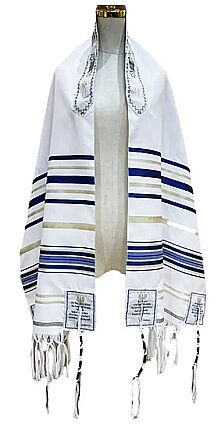
This a typical Tallit
Due to security concerns, as well as reasons of respect for the צִיצִיּוֹת - Tzitzit, it was decided that the the Tallit (Prayer Shawl) would be exclusively used for ritual occasions. The Tallit, which is correctly called a “Tallit Gadol” (large Tallit), being unlike the smaller square “Tallit Katan”, which is worn under other garments all day long!
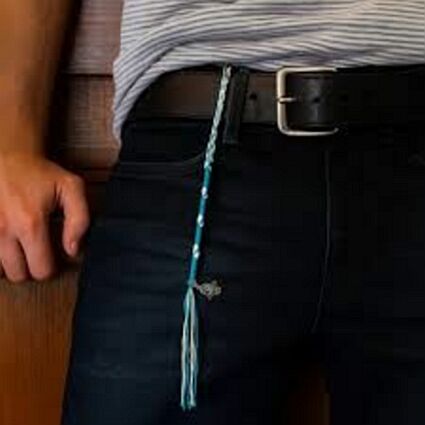
Above and below: The white and blue Tzitziot is placed on the four corners of both the “Tallit” and the “Tallit Katan”.
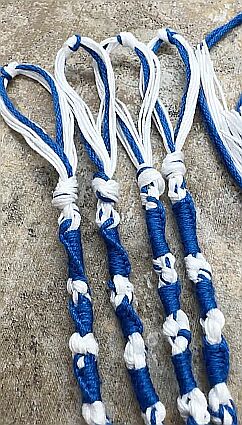
The Torah contains a precept that the Tzitzit must have a thread of a special sky-blue colour, called “Petil Techelet”. Originally, one thread of each Tzitzit was dyed with a blue dye (Techelet).
As
Bemidbar - Numbers 15:38
clearly stated:
“Speak unto the children of Israel, and bid them that they make them throughout their generations fringes in the corners of their garments, and that they put with the fringe of each corner a thread of blue”.
The occasions on
which the Tallit is worn are the morning service on
weekdays, as well on Shabbat, Yom Tovim (holidays, and fast days (however not
on and fast days (but not on Tisha B’Av); the evening service on Tisha
B’Av; and on Yom Kippur Eve, before Kol Nidrei,
when it is worn before nightfall.
Below is a general view of the times to wear the Tallit:
1... Morning Services (Shacharit):
Daily: Worn during Weekday, Shabbat and Yom Tovim
(Festival) morning prayers.
Reason: The mitzvah of Tzitzit is linked to seeing
the fringes (Numbers 15:39), which applies during daylight hours.
2...
Yom Kippur Evening (Kol Nidrei):
Exception: Although it’s nighttime, the Tallit is worn due to the sanctity of the day.
Symbolism: Represents purity and divine protection as one
enters the Yom Kippur (Day of Atonement).
3... Torah
Aliyah:
Those called to the
reading of the Torah will wear a Tallit, even if they
don’t wear one regularly at other times.
4... Morning
prayers: If at home:
5... Weddings: Sometimes worn by the
groom, or it is used as a chuppah (canopy).
6... Funerals: Placed on the deceased,
often with one Tzitzit cut to signify release from mitzvot.
7... Tefillin: During laying our Tefillin.
However, whenever Tefillin is laid, the Tallit is put on first, since the Tallit
being an daily mitzvah, thus it takes precedence.
The Tallit Katan is obligatory to be
worn as long as the sun is above the horizon, or the sun is bright enough to
recognize a friend four steps away, so at night their use is not obligatory.
Times to wear
the Tallit:
1... Morning Services (Shacharit):
Daily: Worn during Weekday, Shabbat and Yom Tovim
(Festivals) morning prayers.
Reason: The mitzvah of Tzitzit is linked to seeing
the fringes (Numbers 15:39), which applies during daylight hours. But there are
those who will wear it at other times as well.
2...
Yom Kippur Evening (Kol Nidrei):
Exception: Although it’s nighttime, the Tallit is usually worn due to the sanctity of the day.
Symbolism: Represents purity and divine protection as one
enters the Yom Kippur (Day of Atonement).
3... Torah
Aliyah:
Those called to the
reading of the Torah will wear a Tallit, even if they
don’t wear one regularly at other times.
4... Morning
prayers: If not at the Synagogue, can do so at home.
5... Weddings: Sometimes worn by the
groom, alternatively it is used as a chuppah
(canopy).
6... Funerals: Placed on the deceased,
often with one Tzitzit cut to signify release from mitzvot.
7... Tefillin: During laying our Tefillin.
Now let us look at a wonderful Thought:
Now here is something to think about of adhering to the blessed Mitzvot we have been asked to uphold. Did you know that the Tzitzit serve as a visual and tactile reminder of the 613 commandments. The word צִיצִיּוֹת - Tzitzit has a numerical value of 600, however, when you add the 8 threads and 5 knots, you will find that it adds up to 613, covering all our beloved Mitzvoth as found in the Torah!
Thus
the word צִיצִיּוֹת has a total gematria of 606.
Of
course this number is deeply symbolic in our Hebrew Jewish tradition. The
mitzvah of Tzitzit is associated with the number 613
- the total number of commandments, because: The word ציצית
(singular) has a gematria of 600.
Yet add 8 threads and 5 knots, this then equals 600. However, add 8 threads and
5 knots makes up; 600 + 8 + 5 = 613.
|
Letter |
Name |
Value |
|
צ |
Tsadi |
90 |
|
י |
Yud |
10 |
|
צ |
Tsadi |
90 |
|
י |
Yud |
10 |
|
ו |
Vav |
6 |
|
ת |
Tav |
400 |
For Interest: “gematria” is a form of numerology based on our Tanakh. In our faith gematria provides a basis for numbers having religious and/or spiritual symbolism, and as we should all know, our Ivrit – Hebrew alphabet is numerical!
Who wears it?
In many communities, the chazzan wears the Tallit during the daytime and evening services, when other
worshippers will wear it during the day services.
Among Ashkenazim
in Diaspora communities, boys under the age of 13 generally wear small Tallitot and will receive a larger prayer shawl as a gift
from their father at their Bar Mitzvah.
The practice
among Sephardim and Eastern Jews is that single, thus all men must wear a Tallit; whist the Chasidim, only married men can do so.
YYYYYYY
In Conclusion, a Question to Deepen the
Conversation:
Which
part of this Tanach guide or a line within it has touched you the
most? And how do you feel about spending more time on your Tanakh study time? I
pray that you are you doing well as a faithful Hebrew, and אֱלֹהִים - Elohim willing you are upholding as many of
our blessed Mitzvoth’s as possible?
I
am well aware that the modern world sadly contains far too many deviations as
well as problems that tend’s to
get in the way. More than that, sadly there are all sorts of enticements, which
is able to throw so many off track. Thus, if
there are various struggles that may be taking place in your life at this or
any time, I am well aware that it can have sad and cruel effects upon your
life? Remember this, pray for peace, and then work on keeping as calm
as possible and learn to improve your life in אֱלֹהִים.
This site is also for those who need to return to our wonderful faith, thus
work on your faith and pray and always seek אֱלֹהִים -
Elohim’s guidance, blessed be He!
Remember what אֱלֹהִים -
Elohim, blessed be He, said ...
“Return unto Me, and I
will return unto you, saith צְבָאוֹת-יָהוָה - the LORD of hosts”. Mal’a’chi - Malachi 3:7. MEC).
And Remember ...
Enjoy your Sabbath Rest - Shabbat Shalom!
אֲנִי
יְהוָה
אֱלֹהֵיכֶם,
בְּחֻקּוֹתַי
לֵכוּ;
וְאֶת-מִשְׁפָּטַי
שִׁמְרוּ,
וַעֲשׂוּ
אוֹתָם
וְאֶת-שַׁבְּתוֹתַי,
קַדֵּשׁוּ;
וְהָיוּ לְאוֹת,
בֵּינִי
וּבֵינֵיכֶם--לָדַעַת,
כִּי אֲנִי
יְהוָה
אֱלֹהֵיכֶם
“I am אֱלֹהֵיכֶם יָהוָה (the LORD
your God); walk in My statutes, and keep Mine
ordinances, and do them; and hallow My Sabbaths, and they shall be a sign
between Me and you, that ye may know that I am אֱלֹהֵיכֶם יָהוָה”. Yechezkel
- Ezekiel 20:19-20. (JPS).
YYYYYYY
“Hebraic Studies” motto is as follows;
“The More
Torah, the More Life”,
For our Elohim is the One who
gave us our ... Life!
May the שָׁלוֹם -
Shalom (Peace) of צְבָאוֹת-יָהוָה (the LORD
of hosts) be with you, and please always uphold our blessed שַׁבָּת -
Shabbat, as well as the ‘מוֹעֲדִים - Mo’a’dim - Feasts, and continue saying
your daily תְּפִלָּה - Te’fee’lah (Prayers) and regular בְּרָכָה - Be’ra’chah (blessings) before food and
drinks, etc!
Rabbi, Dr. Reuven Ben
Avraham-Goossens, PhD.
iiEnter the Main Site IndexI
or use the
link below
http://www.hebraicstudies.net/Site-Index.htm
0Or Return to the FRONT PAGE0
or use the
link below
https://www.hebraicstudies.net
-hebraicstudies.net-
Email the Rabbi
Although the author does not believe in having to copyright
“Hebraic Studies” which commenced in the mid 1980’s
but there have been occasions where there
parts of his
studies have been taken and quoted out of context
and thus the Rabbi’s name has been
misquoted by those who have their own reasons for doing so.
Copyright © 2025 - “Hebraic Studies” - All
rights reserved.